Mack
The One and Only IvanMack’s significance lies in the tension between his personal familiarity with the animals and his authority over their confined lives. As boss of the Exit 8 Big Top Mall and Video Arcade, he oversees a business built around scheduled animal shows; as the person who bought and raised Ivan, he also occupies a place in Ivan’s earliest memories. Those roles coexist without resolving into either simple affection or simple cruelty. The account repeatedly places his tenderness and control side by side, making the animals’ dependence on him part of the story’s central conflict.
Identity and Background
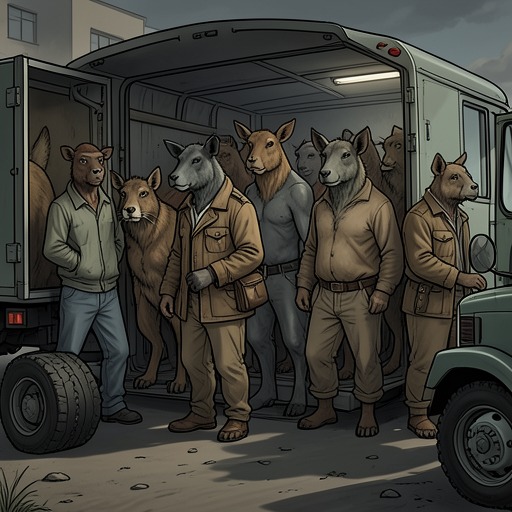
Mack is the boss of the mall, a human habitat located off Interstate 95, where shows take place at two, four, and seven every day of the year. He is associated with the practical rhythms of its operation: when the telephone trills, he answers it. His position gives him authority over a venue in which animals perform for visitors, while the regular show schedule makes their display a routine commercial activity rather than an occasional event.
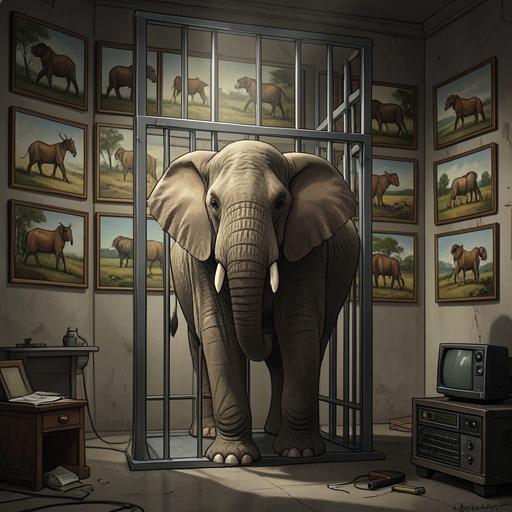
The mall’s setting frames Mack’s power in concrete terms. Animals live among the merchants, a creaky-music carousel spins through the day, and visitors sit around the central ring to eat pretzels and watch. Sawdust covers the floor. Mack’s job is not described separately from this environment: he is the person in charge of a place where animal bodies, entertainment, and business meet.
Raising Ivan
Mack’s relationship with Ivan began when Ivan was still in a crate. Mack pried it open, bought him, and raised him as if he were a human baby. Ivan wore diapers, drank from a bottle, slept in human beds, and sat in human chairs while human speech surrounded him. These details establish a history of close physical care and domestic intimacy; Ivan’s earliest life with Mack was not limited to the public performance space of the mall.
That intimacy does not make Mack a consistently protective guardian. Ivan’s recollection places his early dependence on Mack alongside Mack’s ownership of him, and the contrast matters: Mack gave the young gorilla a human household routine, but he also brought him into a life in which Ivan was kept and exhibited. The evidence holds both facts together rather than presenting the nurturing history as proof that the arrangement was free or equal.
Mack had a wife, Helen, during this earlier period. Ivan remembers her as quick to laugh and quick to anger, especially when he broke things, which happened often. Her presence situates Mack’s care of Ivan within a household, but the account gives no further explanation of their relationship or of how long that domestic arrangement lasted.
Control and Training Ruby
After Stella’s death, Mack is absent for two days. When he returns, he does not talk about Stella. Instead, he speaks of teaching Ruby tricks, notes that the billboard is bringing more visitors, and presents the moment as a new beginning. The sequence links Ruby’s training to the mall’s renewed business prospects, while the silence about Stella marks a sharp contrast between the loss that has just occurred and Mack’s quick turn toward the next performance.
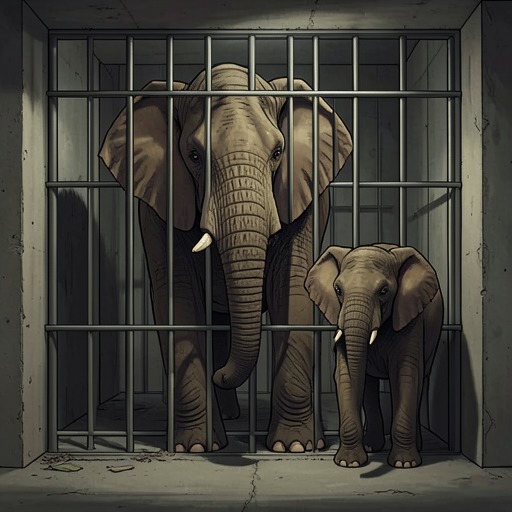
The training begins with Ruby physically restrained. Rope loops around her feet so she cannot run, and a heavy chain hangs from her neck. Mack shows her Stella’s ball, pedestal, and stool, then introduces her to Snickers. When Ruby obeys, he gives her a cube of sugar or a piece of dried apple; when she does not, he yells and kicks at the sawdust. The routine makes obedience the condition for small rewards and places the young elephant’s movement under direct control.
George eventually calls over from the food court and offers to close up, suggesting Mack call it a day. Mack instead yanks Ruby’s chain. When she remains anchored, he pulls harder and falls to his knees. He brushes sawdust from his jeans, declares that he is through playing around, and walks to his office. The moment turns frustration into a change of method: Mack returns carrying a long stick tipped with a gleaming hook, the claw-stick, and touches Ruby with its sharp point. The touch is described as not hard, but the tool’s appearance and the deliberate escalation make clear that coercion is now part of the training scene.
Protest and Public Conflict
The billboard brings more visitors, but public attention also develops into opposition. Protesters arrive with signs and pictures, including one depicting a gorilla cradling a baby elephant. They want Ruby freed; some also want the mall shut down. The image of an animal caring for another animal contrasts with the restraints and training taking place inside the mall, while the protesters’ demands challenge the business that Mack runs.
Mack discusses the demonstrators with George in the evening. He says they are protesting the wrong person, predicts that they will ruin everything, and directs his frustration toward George with a bitter expression of thanks. His response shows that he experiences the protests as a threat to the mall and disputes where responsibility lies. The account does not establish whether he accepts any criticism of the animals’ treatment; it shows instead that he rejects the protesters’ target and fears the consequences for the business.
Change and Narrative Significance
Late at night, Mack opens Ivan’s cage. Moonlight falls on his sagging shoulders, and he seems smaller than before. Bob, who had been lying on Ivan, immediately leaps away and hides beneath Not-Tag. Mack knows the dog sleeps there and settles onto Ivan’s tire swing. He says Ivan’s buddy is leaving the next day and suggests staying one more night. The quiet visit differs markedly from Mack’s public authority and his forceful handling of Ruby: here he enters Ivan’s space, sits on the swing, and speaks in the shadow of an imminent departure.
The scene does not erase the control that defines Mack’s position, nor does it explain his feelings beyond what his changed appearance and words convey. Instead, it complicates the picture of the boss who answers the phone, runs the shows, and directs animal training. The same man who raised Ivan through bottles, diapers, and human beds now governs a commercial animal enclosure; the same man who uses chains and a hooked training stick also opens Ivan’s cage and remains with him on the last night before his companion leaves. That unresolved contrast gives Mack his narrative force: he is both a familiar presence in the animals’ lives and the human authority that confines and displays them.